
- My Review + Thoughts
- Chapter-by-Chapter Summary
- 👴🏻 Introduction
- 🏠 1. The Limit-Embracing Life
- 🪤 2. The Efficiency Trap
- 🔚 3. Facing Finitude
- 🥱 4. Becoming a Better Procrastinator
- 🍉 5. The Watermelon Problem
- 🕺🏼 6. The Intimate Interrupter
- ⌛ 7. We Never Really Have Time
- 📍 8. You Are Here
- 🛏️ 9. Rediscovering Rest
- ⏱️ 10. The Impatience Spiral
- 🚌 11. Staying on the Bus
- 👨🏼💻 12. The Loneliness of the Digital Nomad
- 🌌 13. Cosmic Insignificance Therapy
- 😷 14. The Human Disease
- 🙏 Afterword: Beyond Hope
- 🔧 Appendix: Ten Tools for Embracing Your Finitude
- My Final Thoughts + Who is it For?
My Review + Thoughts
What’s it About?
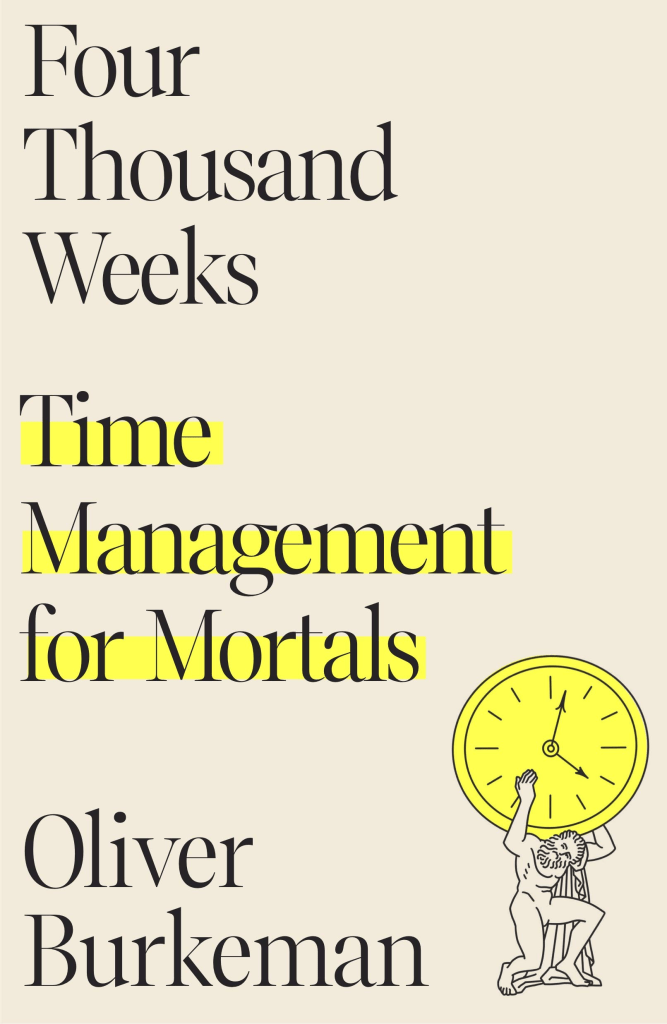
4,000 Weeks: Time Management for Mortals is an anti-productivity book. It meditates on the finitude of life and how it is frankly impossible to do, achieve, and see all that you might want to—but that’s an empowering thing.
In fact, you should embrace life’s finitude. Every thing you do becomes that much more meaningful because you’ve rejected every other thing you could be doing at that moment. We live in a culture steeped in the fear of missing out, but with this shift, you can experience the joy of missing out instead.
There is more to life than work, and you shouldn’t constantly wait to live your life. This book is not saying that you shouldn’t work and be totally hedonistic, rather that you should accept and embrace life’s limits and find joy in the process of life. If you won’t let yourself enjoy and be present in life until you reach a certain outcome, you’ll simply miss out on life.
“Results always come later—and later is always too late.”
Chapter 9
You get to feel pain, you get to feel frustration, and you get to feel joy and all of the good things in life. This coincides with the Stoic principle of Amor Fati, to love everything that happens to you. As I’ve recently been reading more Stoic and Zen philosophy, I’ve realized this book largely presents many similar ideas in an extremely digestibly way, such as outcome independence, accepting what cannot be changed, and embracing the current moment.
What Did I Learn?
Personally, I realized that I have been taking far too much of life either for granted or instrumentally—meditating for better productivity, worried too much about my employment situation or work when spending time with loved ones, and constantly believing I need only be better, faster, or more efficient to get the life I want.
Life isn’t a race, it’s just a series of moments. I don’t want to waste my life, waste any moments with loved ones, or lose joy in the things I do. I will do what I can, and I won’t do what I cannot, and it’s okay to have limits. Life eventually ends, whether you want it to or not, so don’t put off living it.
This book made me have these realizations, and it’s dramatically changed how I view life. Of course I will still strive for success, but I am much less concerned with the outcomes of anything in particular, content with doing my best on the process and the process alone, enjoying each step of the way.

My 3 Biggest Takeaways
- Life is finite, and accepting that gives you freedom—you can’t do everything you want to, making what you do all the more meaningful.
- Not everything needs to be an instrument for productivity or some end goal—don’t feel guilty if you enjoy rest for rest’s sake and leisure for leisure’s sake.
- You don’t matter in the grand scheme of things, and that should empower you; however, you do matter to those around you and the places you can meaningfully make a difference.
Chapter-by-Chapter Summary
👴🏻 Introduction
A human lives around 4,000 weeks. Why waste your life on productivity alone when the world is so full of wonder to fill your life with? Life is meant to have wonder in all its areas—trying to be excessively productive and efficient are a trap which sap life’s wonder in an attempt to control what cannot be.
Part I: Choosing to Choose

🏠 1. The Limit-Embracing Life
You will never be in total control. Embrace that instead of fighting against it. Reject the belief you can ever manage all your demands, and reject the notion that a moment only has value if it has future utility (IE. Investments, “recharging” for leisure instead of leisure for leisure’s sake)
You can’t avoid the limits of reality, but you can respond to it and accept your role in your life and its place in history.
🪤 2. The Efficiency Trap
If you don’t have the time, you don’t have the time, and that’s okay.
Efficiency won’t give you more time, rather it will make you more astutely aware at your perpetual perceived lack of it. Getting better at email results in more email. High performers are punished with more work.
You will miss out on almost every wonderful experience you might have, and that’s okay.
🔚 3. Facing Finitude
Face the finitude of life. You will die, and understanding that will make you more present in the life you have.
4,000 weeks is a small number, but it’s infinitely more than if you’d never been born. You won’t fit everything you might want to do into this time, but choosing what not to do makes the things you do that much more meaningful.
🥱 4. Becoming a Better Procrastinator
Schedule time for yourself and prioritize it as much as you do work.
Always set upper limits for work time—always leave more in the tank.
Say no to things you want to do if they’re not supremely important—reject middling priorities and experience the joy of missing out.
🍉 5. The Watermelon Problem
Your reality is defined by what you pay attention to. Thus, your attention should be reserved for what matters most to you.
For an experience to have meaning, you need to pay attention to it, rather than how many of us willingly give in to distraction to avoid our fears and confronting life’s finitude.
🕺🏼 6. The Intimate Interrupter
Distraction is an attempt to flee the fear and pain of confronting life’s finitude. Killing time (online, etc) isn’t fun, but it feels better than confronting that we will die.
To overcome distraction, stop expecting life to be painless, and stop expecting things to go how you want them to. Zen Buddhism states human suffering comes from resisting mindfulness to how life is because we wish it were different. Accept life as it is.
Part II: Beyond Control
⌛ 7. We Never Really Have Time
According to Hofstadter’s Law, tasks always take longer than planned, so why set expectations if you will always be disappointed?
Stop expecting reassurance that the future will turn out how you want it to, whether in small tasks or in life—the best parts of your life likely happened by chance anyways.
“All a plan is—all it could ever possibly be—is a present-moment statement of intent.”
📍 8. You Are Here
Stop treating everything in life as a utilitarian means for some future outcome; stop postponing fulfillment and happiness.
Life is only the present moment, a string of moments that were the present and moments that will be the present, and any moment could be your last.
You are the moment, you are time. By trying to make the most of your time, you miss your life.
🛏️ 9. Rediscovering Rest
Leisure doesn’t need to be an instrument for productivity: leisure can (and should) exist for its own sake.
Wasting time on leisure pointless to your goals is true leisure. You don’t need to constantly strive for something even when resting, no matter how uncomfortable capitalism makes you feel doing so. Why postpone fulfillment to a future you aren’t even guaranteed?
“Results always come later—and later is always too late.”
⏱️ 10. The Impatience Spiral
Things are the way they are, so stop wishing they were different. Trying to fall asleep wakes you up, just like trying to rid yourself of anxiety only increases it.
Face things the way they are, openly and graciously. Ironically, accepting your anxiety is the best way to relieve it.
🚌 11. Staying on the Bus
Patiently persevering through the discomfort of the unknown often leads to the solution.
Follow the Three Principles of Patience:
- Develop a taste for having problems. Accept (and enjoy) having problems—life is a series of constant problems, and that’s how it is!
- Embrace radical incrementalism. Make things a smaller part of your routine. Set limits and stick to them no matter how much energy you have.
- Originality lies on the far side of unoriginality. Patience by going farther on the well-trodden path often leads to more originality than forcing unconventionality too early on. Know the rules before you break them.
👨🏼💻 12. The Loneliness of the Digital Nomad
Free time is best spent with other people. Happiness comes when your free time aligns with others, like high school breaks, or the Sabbath.
It’s worth removing flexibility if you can develop a rhythm of time with those you care about.
”Your time can be too much your own.”
🌌 13. Cosmic Insignificance Therapy
You don’t matter (in a cosmic sense), and that’s empowering.
If all things are so insignificant, why worry about them? Why worry about trying new things, pursuing a creative endeavor, or anything else if the stakes for failure are astronomically low?
You don’t need to be the best at something, as 1,000 years or 1,000,000 years from now, none of it will matter. You do you, and do what you can without worrying about a grand future impact.
😷 14. The Human Disease
We are time, so there’s no way we’ll ever be better than time, because it is us.
Consider five questions to help your relationship with time and work:
- Are you pursuing comfort when discomfort is needed?
- Are your standards impossibly high?
- Are you unable to accept the gap between who you are and who you want to be?
- In which areas o you feel the need to hold back until you’re ready?
- What would you change about your days if results didn’t matter?
All we can ever aspire to do is what is next and most necessary, even if we forever lack objectivity in knowing exactly what that is.
Bonus Bits
🙏 Afterword: Beyond Hope
Give up on hope. The world is full of uncertainty and tragedy, and wishing it were different won’t change it.
Give up on what’s impossible, then do what is possible. Hope doesn’t make a difference, empowered action does.
“Hope is not a strategy” — Tim Ferriss (not in this book)
🔧 Appendix: Ten Tools for Embracing Your Finitude
- Set limits on productivity
- Work sequentially, one big project at a time
- Choose what to do badly (to spend more time on what matters most to you)
- Celebrate your wins as much as you plan next steps
- Pick how you will be charitable, and it doesn’t need to be everything
- Make technology boring
- Find novelty in everyday life
- Be a curious researcher in relationships rather than seeking outcomes
- Simply be generous, instantly
- Get comfortable being bored—do nothing sometimes
My Final Thoughts + Who is it For?
Work culture around the world, especially America has ruined so many lives with the obsession with productivity, efficiency, and convenience. So many people are missing out on life because their single goal is a secure future when the only guaranteed time you have is this moment. Of course, there’s nothing wrong with setting goals and striving toward them, but don’t focus so singularly on a goal that you forget to live life.
I think everyone should read this book, and as someone who works in marketing and understands not everything is for everyone, I don’t say that flippantly.
If I’ve convinced you to give it a read, you can use my Amazon affiliate link here to help support me on my endeavors! Otherwise, thank you for taking the time to read my review and summary of 4000 Weeks: Time Management for Mortals
 Andy Cormier