
Mountain Ocarinas are back from the dead! Given today is Halloween, that’s a perfect title.
Refer to the video review for sound samples and more detailed live comparisons.
Who are Mountain Ocarinas?
Mountain Ocarinas are a relatively unique ocarina maker, focusing on portability and durability in their design without sacrificing sound qulity in their instruments. The company has been around for at least 14-15 years, posting videos as early as 2008. The selection of these ocarinas included ocarinas made of polycarbonate plastic, stone, and wood, and all models were built to withstand even the most rugged of conditions. They were so confident in the durability that they had a “dinosaur guarantee,” where even if you went back in time and your ocarina was stepped on by a dinosaur, if it somehow broke, they’d replace it free of charge.
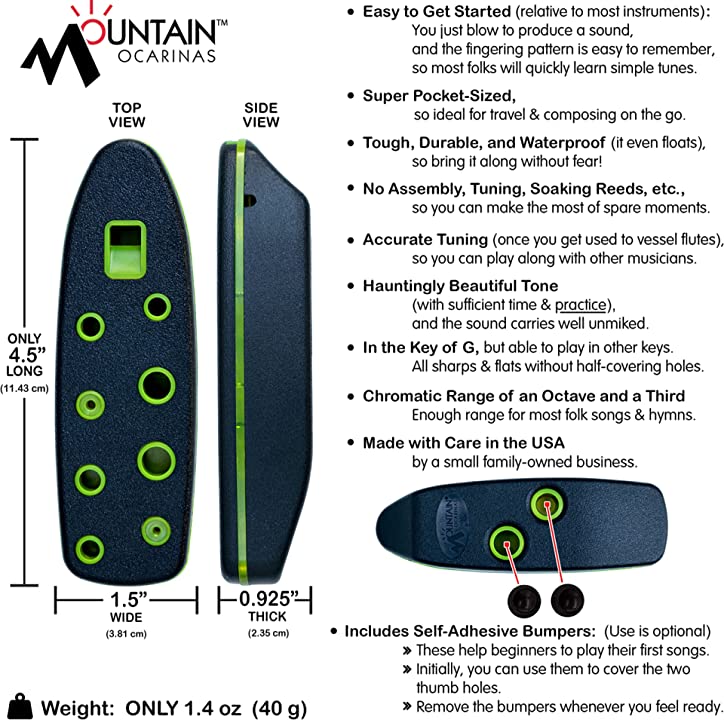
Sadly, within the last few years, Mountain Ocarinas shut down operations to focus on the founder’s (Karl Ahrens) other project: Coda EDC (Coda Every Day Carry Flute—a review of that coming soon). However, as of very recently, Mountain Ocarinas have started to come back!
Fun fact: my 3rd and 4th ocarinas in my collection were the two-pack of polycarbonate C and G Mountain Ocarinas, the first 2 being from STL. I’ve had these ocarinas since 2011, the year I started playing the ocarina, so they’re very dear to me! Furthermore, the ocarina community were quite big fans of this company as well, despite their non-traditional approach to the craft of ocarinas.
What are Mountain Ocarinas?
We’ve already gone over the durability aspect, but Mountain Ocarinas are inline ocarinas with linear fingering. Most ocarinas with linear fingering are transverse, the shape you’d typically expect, so from shape alone, they’re quite unique. The differences don’t stop there—Mountain Ocarinas have a slightly different fingering chart compared to most transverse ocarinas, as well as a reduced range due to only having 10 holes (with 9 holes for the currently unavailable alto C model).
The Mountain Ocarina in the key of G has a fully chromatic range of F#5 to B6, which is an octave plus three, compared to the octave plus five range of a 12-hole ocarina. A 12-hole soprano G would have one additional note above and below the Mountain, with a range of E5 to C7.
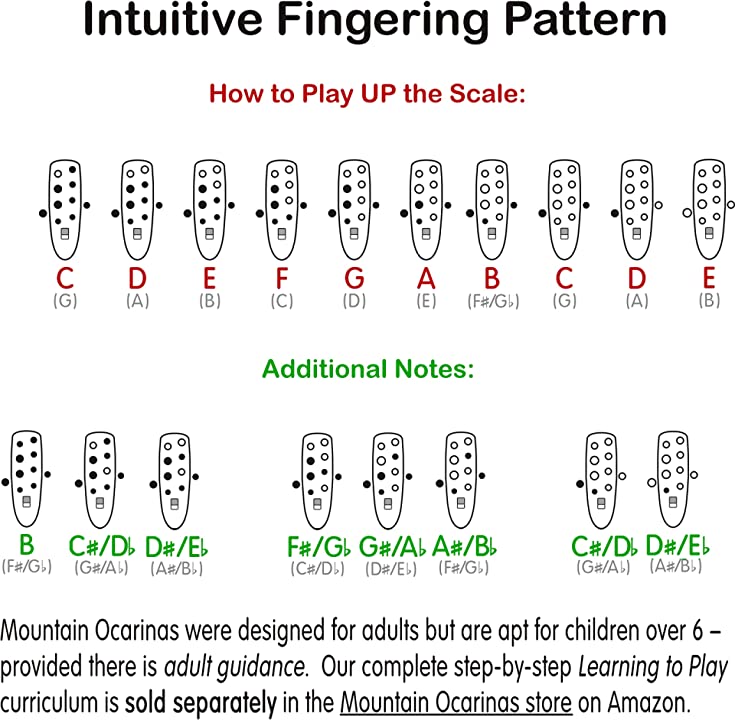
Unlike transverse ocarinas, you keep the pinky up and only drop it for the low F#. Similarly, you also reverse the order you lift the thumb holes—on a typical transverse, it’s left then right, whereas on Mountain, it’s right then left (which is like a pendant ocarina)
While this reduced range is a slight detriment compared to the already limited range of 12 hole ocarinas, it allows Mountain Ocarinas to maintain a significantly smaller size for comparable ranges—since they don’t need to fit subholes, they can make a much narrower instrument.
Fingering, shape, and range differences aside, we have the most important question: how do they sound?
They sound great. They have a much brighter sound than most transverse ocarinas, giving them a tonal quality somewhere in between celtic tin whistle and a typical ocarina.
Comparison to Original vs. New
Now, how do the new Mountain Ocarina (currently only available on Amazon) compare to the original? They seem exactly the same, aside from the new one having green trim while the original is gray and different neck straps. The old is a somewhat rigid plastic strap, whereas the new has a more flexible fabric strap, which I personally prefer.
In terms of sound, does 11 years make any difference?
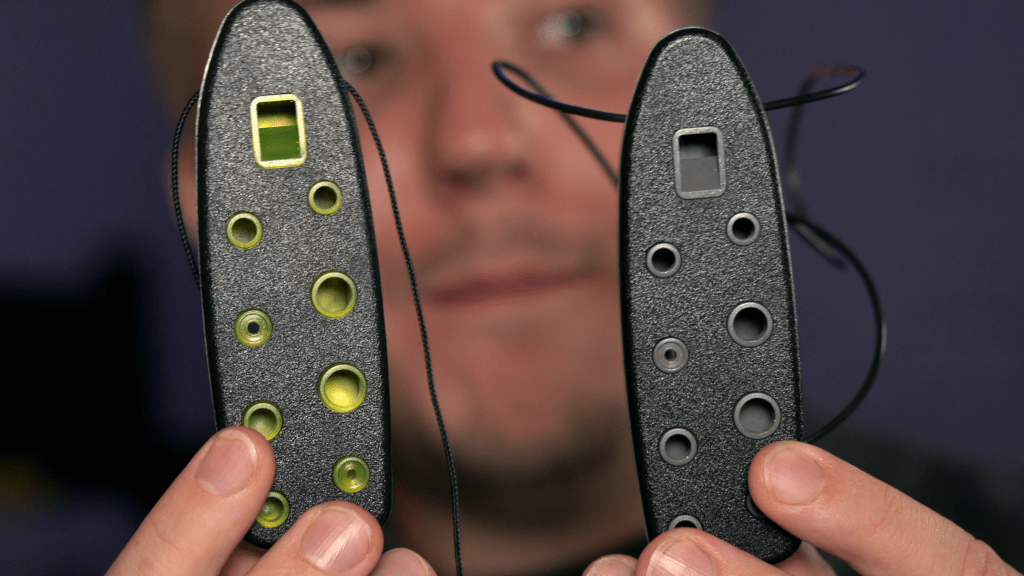
Demonstrably, the old and new Mountain Ocarinas sound exactly the same. The only differences are in minor aesthetics and the material of the neck cord.
Do I Recommend the Mountain Ocarina?
Yes—I emphatically recommend Mountain Ocarinas. That said, there are caveats to whether they’re right for you. If range is especially important to you, I’d recommend a 12-hole. If your musical goals are entirely in the realm of more normal ocarinas and you don’t want to learn a different fingering pattern that no other ocarinas use (that I know of), don’t bother! Whenever I pick up my mountain ocarina, it does mess with my 12-hole muscle memory for the first few minutes, so if that friction isn’t worth it, you don’t really need it.
However, if you want an instrument that’s especially portable as ocarinas go, outrageously durable, and still a competent instrument, it’s perfect. It warrants its price of $39.95, which is a bit more than the Night by Noble’s $35ish. I would still recommend the Night by Noble more for most people, as it is wider in range, similarly as durable, and a better stepping stone to more advanced ocarinas, but for almost any ocarinist, the Mountain Ocarina will be an extremely welcome addition to your collection. It’s perfect to bring on trips, to carry with you every day, and to make music wherever you go!
These are fantastic instruments, and I am so excited that Mountain Ocarina is back from the dead.
 Andy Cormier