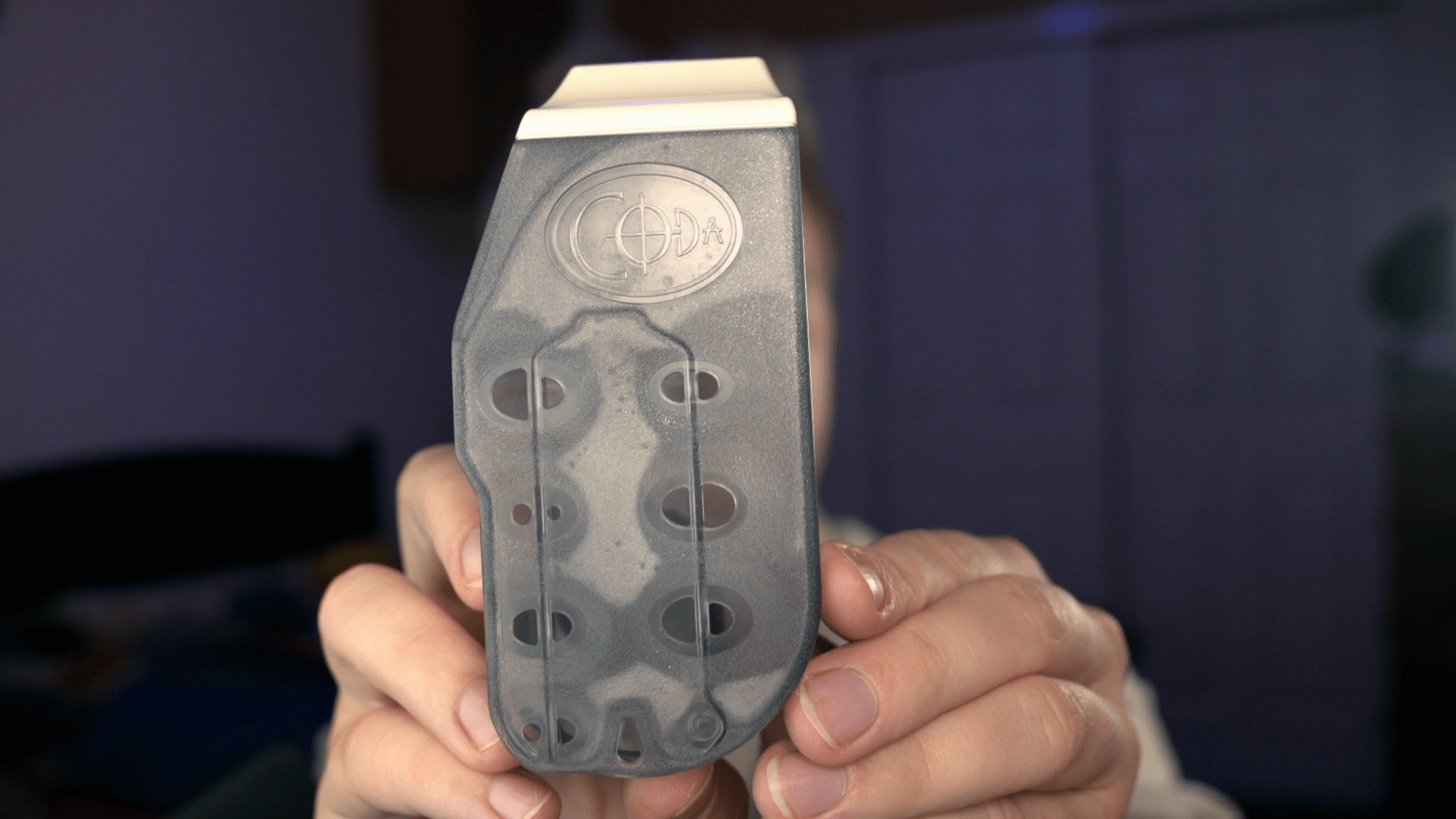
What is the Coda EDC Flute?
We’re back with an Ocarina review! First, refer to the video above for any and all sound references. Today’s instrument is the Coda Every Day Carry Flute, a unique double ocarina by Karl Ahrens, who’s also the founder of Mountain Ocarinas.
You can purchase the Coda EDC Flute for around $60 on Amazon, affiliate link here. The Coda, like Mountain Ocarinas and the Night by Noble, is of very reputable make. Furthermore, compared to most double ocarinas, the $60 is extremely affordable.

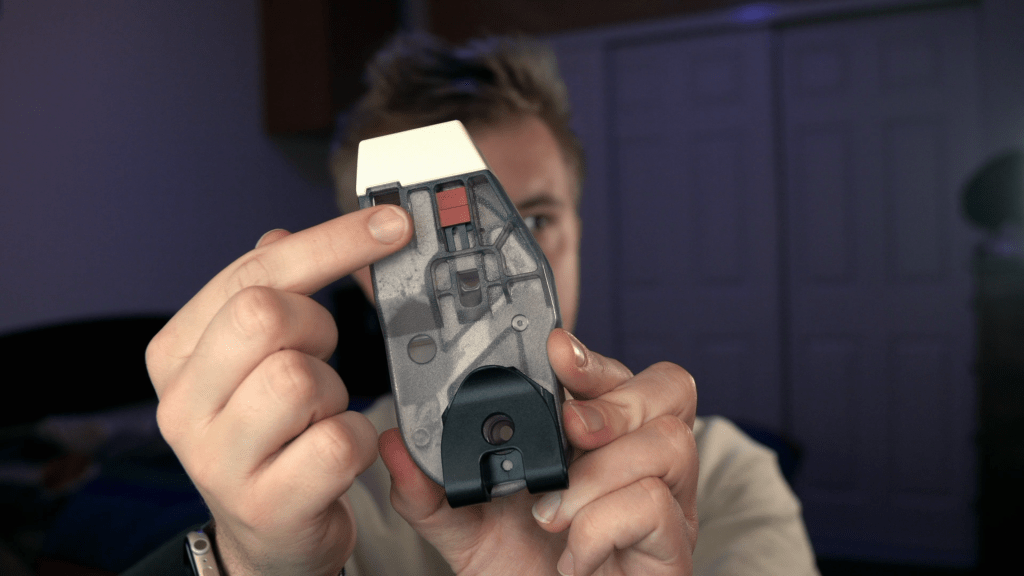
In the package you’ll get a note for learning resources on the superb codaedc.com website, a fingering chart with some sheet music, the instrument, a carrying pouch, and two mute plugs. You can insert them like so, and the ocarina will sound like pitched air, allowing you to even play so quietly that you won’t wake someone sleeping the next room over.
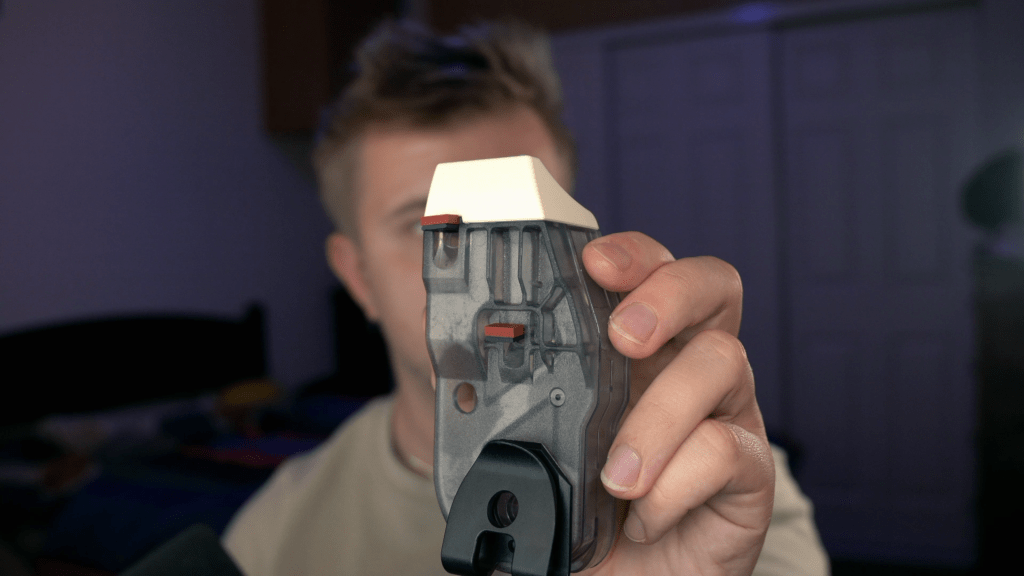
There’s even a little slot to store them.
Demo + Review
The main premise of the Coda is two octaves in your pocket, and judging by the form factor, they’ve succeeded. It’s a tiny, fully chromatic double ocarina in the key of C with a range of B4 to D6 (an octave plus two) in the 1st chamber and B5 to C7 in the 2nd. chamber
Basically, it’s the range of a 12 hole Alto C and a 12 hole Soprano G combined across two chambers.
First off, it sounds good, really good for a plastic ocarina. It’s a bit less bright than Karl’s other instruments, the Mountain Ocarinas, but it’s still brighter than most ocarinas. Next, it’s supremely impressive in its innovative design. It’s two ocarinas in one, and the fingering holes are all intuitively placed next to each other, which both chambers being congruent in their octaves—you can play a full C to C scale (each an octave apart) at the same time by covering all the same holes.

The Coda has medium breath pressure teetering on high, and it has fairly stable breath pressure throughout—you only need to add a little bit more air as you ascend the scale.
The only immediate comments I’d have is that there’s just a few awkward things, but this isn’t necessarily criticism. Compared to a traditional multi chamber, ocarina, there are a lot more stakes with swiching chambers. If you’re going from an F on the 2nd chamber to a C on the 1st, you have to lift all your fingers while switching chambers.
Similarly, the fingerings for many sharps and flats are not what you’d expect. The low C sharp is achieved by lifting your right thumb on the 1st chamber and by raising your right pinky while lowering your left pinky on the 2nd. F sharp uses the right ring finger on the first chamber and the right middle finger on the second. There are other awkward fingerings for sharps and flats, but the point is that most of these are not what you’d expect from an ocarina or even a Mountain ocarina, which has its own quirks with chromatic fingering.
However, I can let all of this slide because you can frankly get used to the differences with enough practice and because of what an amazing feat of engineering this. Compare the Coda to my Spencer Virtuoso double. The Spencer only has two more notes than the Coda, those being the low B and A on the first chamber, but you can kinda get them on the Coda if you cover all the holes, bend the ocarina down to get the B, and for the A, also slightly cover the fipple hole with your lower lip.
Awkward, but doable given how infrequently you dip below the low C in ocarina music.
Comparison

Given the Coda has the same range as a traditional double ocarina, we’ll start with comparing it with a more traditional double ocarina (we’ll use my Spencer Virtuoso in the video).
A traditional double ocarina frankly is a lot easier to use when it comes to chamber switches. As you play ascending notes on the first chamber, you can prep your hand for the second when you switch, and if you play descending notes on the second chamber, you can prep the first chamber with your left hand when you switch.
With the Coda, you can do no such prep, as high notes on the first chamber have most holes open, and low notes on the second have most holes closed. Songs that only dip between chambers are a lot more difficult here than with a single chamber. Again, this is simply alleviated with practice.
Is the Coda EDC for You?
If you’re expecting the Coda to feel like an ocarina you’re used to, it won’t. It’s technically a double ocarina, but it is very much its own instrument. Come in expecting it to be just like every ocarina you’ve played, and you’ll be disappointed. Treat it as a new instrument to master, and you’ll probably love it.
I love the somewhat bright tone, ultra-wide range, affordable price, convenient mutes, Karl Ahrens’ staple durability, and amazing innovation that makes two octaves fit in my pocket. I do find it awkward to play at times, but that could be alleviated by practice. Even with the more difficult learning curve, I am a huge fan of this instrument.
The Coda EDC isn’t for everyone, and that’s okay. Whether or not it’s for you, it’s an amazing feat of musical innovation and truly has the potential, with practice, to be your every day carry flute.
Thanks for watching this review, and if you choose to buy a Coda, please use the affiliate link in the description—it helps support the channel.
If you’re interested in non-traditional ocarinas, I recently reviewed an instrument from the predecesor to the Coda, Mountain Ocarinas! They’re also amazing little instruments.
 Andy Cormier