
What did you do on January 16th last year? Just give me one thing. Yes, you can check your notes—which is the whole point of this post.
By the way, here’s what I did on January 16th:
- Played DND, my DM tried and failed to kill my character, who was a gnome monk parodying Jeff Bezos
- Had a date night at a Japanese restaurant with my girlfriend
- Planned a hike that we didn’t end up going on
I didn’t remember any of this off the top of my head, but I had it written down in my journal.
This Isn’t Just About Journaling
Journaling is great, but it isn’t a one-size-fits-all solution. It’s great for processing thoughts and feelings, but journaling to process isn’t sustainable to do every day for most people. Instead, I have a few low (or no) friction practices to help remember your life!
Today’s whole concept falls a bit under the idea of a “Second Brain” as discussed in Tiago Forte’s book, Building a Second Brain. The book is about organizing your knowledge and memories in a digital archive and progressively summarizing things to make more useful, digestible notes stored outside your brain for easy reference. Basically, you want to think of yourself as a “giver of notes” to your future self rather than just a taker of notes.
Forte’s book is primarily oriented towards knowledge workers who wrangle lots of information on a daily basis, but every person can be a bit more intentional in recording their life for future reference! It’s not about remembering everything in your head, but rather creating many different ways you can cue yourself to jog your memory. Think of when you look at a high school yearbook years later and have a flood of memories—we’re doing that but for you and your life.
One Line a Day Journaling

The first and arguably my favorite low-friction memory practice is the One Line A Day journal. I used it for about 7 or 8 months last year, with a current streak of around 190 days logging a very short summary of what happened during the day.
Each page has 5 segments, so the idea is you keep this journal for 5 years. I typically write a 1-sentence summary then list what I’m grateful for, like the following (intentionally vague) kind of entry below:
“Lots of writing today! Grateful for actually waking up before 8, landing job interviews, sticking with my diet, my cats cuddling cutely, and leftover spaghetti.”
I don’t actively read through it, but the magic starts to happen when you get into your 2nd year. You get to see all the entries you wrote for the previous year and get a little summary of what you did and how you felt that day.
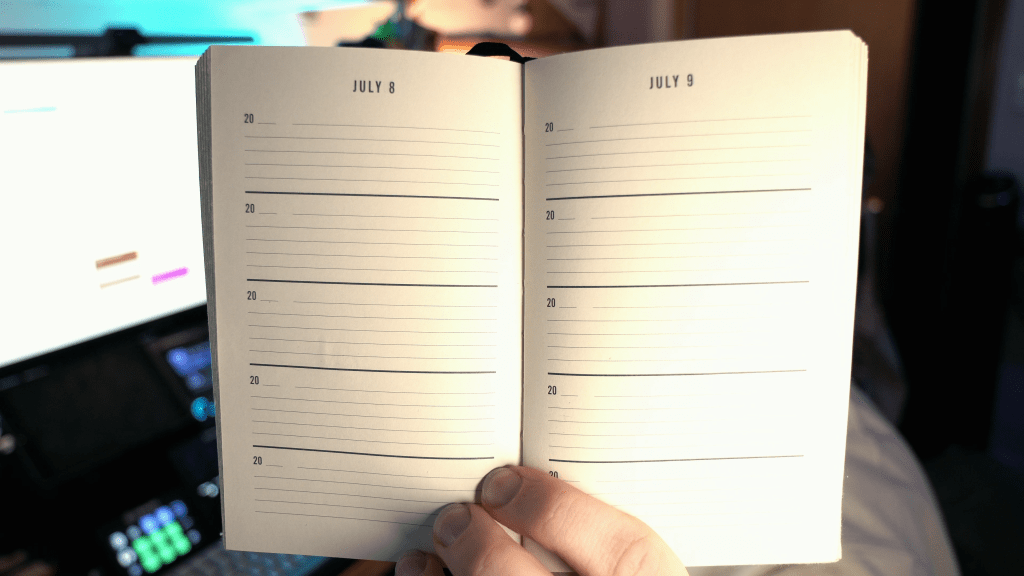
This journal literally takes me about 90 seconds a day to do right before I go to bed, and get this—going through the events of the day helps you fall asleep, so the 90 seconds I spend journaling helps me sleep too!
But had you asked me about this prior to a few weeks ago, I’d just say the sleep benefit was nice, but now that I’ve been doing it since 2022, it’s so cool seeing the entries from last year each day, even in February when half of my entries are just like “There is only Elden Ring.” I’m so grateful to past Andy for helping me remember in this journal.
Digital Journaling is Fine!
Journaling doesn’t have to be physical on a notebook!
My journals for my workout log and my digital detox are literally just a Google sheet with text wrapping enabled. I leave the tabs open and write in them when relevant. My weekly review journal is a Notion template. I occasionally do spontaneous micro journaling in the Apple Notes app.
Tactile journaling does hit different, but a lot of things are FINE to be digital. It’s better to journal at ALL than to require it to be some perfect, romanticized experience. The important thing is having a dialogue with yourself to feel your feelings and process your thoughts or just provide cues for future you to remember. If you find it’s easiest to journal with the Notes app, Notion, or even a spreadsheet, more power to you.
Take Contextual Photos
Almost everybody is carrying a camera with them at all times. And that camera has a lot of fun ways to help you remember things (it’s your phone). One of my favorite features of the iPhone is how it makes little slideshows out of your photos and videos to commemorate “this day last year” or “furry friends” or “Tokyo across the years.” I don’t go through my photos on a daily basis, but it’s nice to see the things I chose to capture over the years.
But this is about being intentional—what do I mean by “Contextual Photos?”
Your phone automatically takes a lot of context whenever you shoot a photo, like location, time, and date. Obviously you can take selfies on a date night or photos of a landscape, but I think it’s important to combine the context of yourself and your setting for these! Photos help provide context for your memories.

I take so many photos that I’ll never post of things I want to remember (or send to my girlfriend), like a selfie on a nice walk, a wide-angle photo of an outing with friends, or a little shot of something I cooked. I treat these photos rather ephemerally in that I often take them and neither post them nor look at them with any regularity, but creating a backlog of little memories ties in so nicely with the memory slideshows my phone makes or to stumble upon when I occasionally look at photos.
These don’t need to be perfect photos either! Lots of people say the obsession with capturing the moment takes you out of it, so make capturing the moment so quick no one even notices you doing it. I like to use the wide-angle lens on my phone to really fit the whole context and not sweat the framing. Quick and unintrusive!

On that note, if it isn’t intrusive and doesn’t take you out of the moment, short videos are also great ways to get the full audio context in addition to video—what did that restaurant sound like? Who all was at your table (who might not fit into the frame of a single photo)? Literally a 5 second video panning across the table is enough, and you can even get most of this benefit with Live Photos on iPhone.
I only recommend video because I take so many photos that I wish I had more videos to look back on too, but you can get started taking occasional, quick, unintrusive photos to commemorate things, whether mundane or special.
This isn’t a recommendation to take a photo of everything you see and do and experience, but a reminder that you have the means to capture any moment you feel is worth recording at any time. Whether you ever post these is up to you, since things like Snapchat and Instagram stories can also be a memory database, but I don’t really feel the need to share everything when the main goal is to help me remember.
Google Maps Timelines
The metadata on your photos isn’t the only way to remember where you’ve been in a GPS sense!
Google Maps has a timeline function that tracks everywhere you go. It’s a little dystopian, and you can disable it, but I enjoy having it on. I can go back to like, January 12th 2020 and see roughly where I was and get a reminder of what I did.
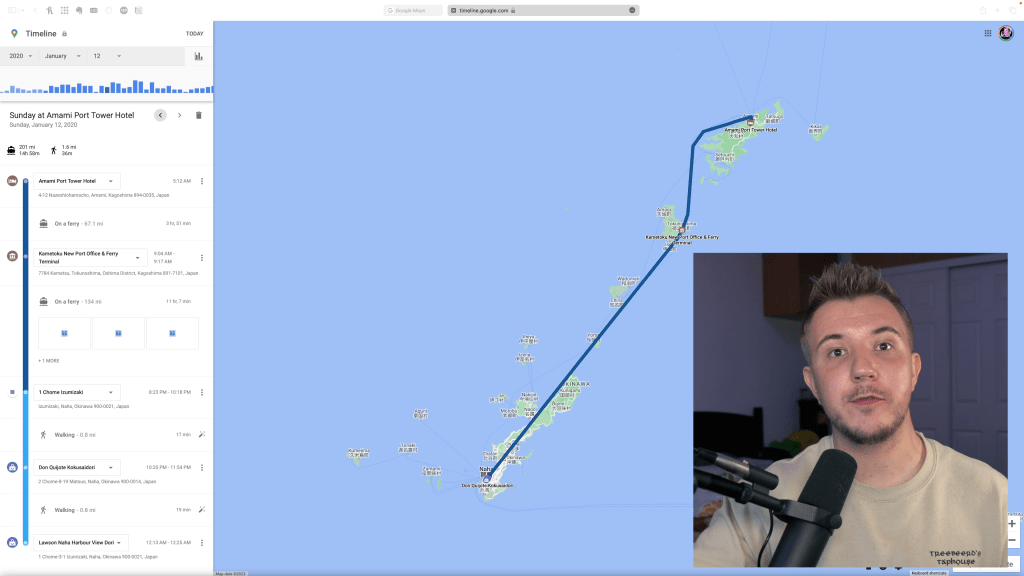
I was in Japan on a study abroad program, and it’s cool to get a little snippet of that, which I can then reference with any photos or videos I took for a multi-faceted, zero-friction memory bank. Even if I totally forget what I did on a particular day, I can usually piece it together between Google Maps’ Timeline, looking through photos or old social media post and even my internet browsing history.
You might not want Google knowing where you are and where you’ve been at all times, but it’s a fun feature nevertheless if you choose to use it. In particular, I can go through my timeline and know exactly when my girlfriend and I have been on dates. Like, we didn’t take any photos on our first few dates, so we both forgot what exact day our very first date was at one point. However, thanks to Google Maps’ Timeline, I can see the exact date.
Not Everything is Worth Remembering
…but building a low-friction practice of capturing memories will make you that much more prepared to remember the big things or even just piece together what you did on a particular day. And who knows…
Maybe what feels like little things now will end up becoming the memories you treasure most.
Try shortform journaling. Don’t sweat journaling digitally if needed. Take short, unintrusive photos and videos frequently. Use technology to remember for you.
Delegating some memory to a journal or device doesn’t mean those memories matter any less. In fact, taking the time to record those memories will help you remember them more, and you get something tangible to look back on.
If you want more videos erring on philosophical, watch a video that literally puts this advice to practice! I went to Ireland to visit my brother last August, and I recorded thoughts on a life-change book I was reading at the time, 4,000 Weeks by Oliver Burkeman (read my summary/review of the book as well).
 Andy Cormier