
I use the term “breath curve” all the time when making my ocarina content, but I realize I’ve never explained what it means. Let’s do that!
What Is A Breath Curve?
The breath curve of an ocarina is best shown as a graph; the X axis is the note you’re playing, and the Y axis is the amount of air you need to play that note. In general, the higher the note you play, the more breath you need.
We’ll go more in depth on charting these graphs later, but let’s start with the three most common types of breath curves!
Types of Breath Curves
Each of these descriptions is an approximation, and I don’t have the scientific tools to actually test these.
↗️ Linear Breath Curves
A linear or near-linear breath curve has a relatively even increase in air needed per note you go up the scale.
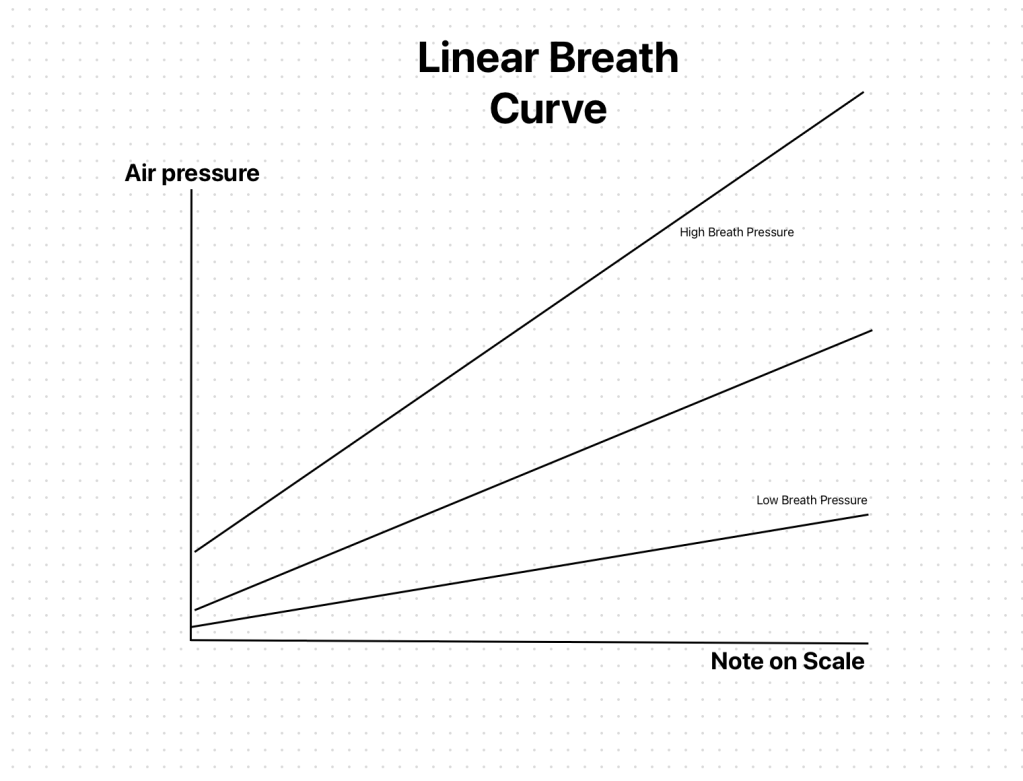
A linear curve or a curve approximately close to it (e.g. slightly concave or slightly convex) is most common and generally considered most intuitive to play, especially for beginners. It does indeed feel most natural to increase your airflow as you ascend the scale, unlike…
↔️ Flat Breath Curves
This kind is uncommon, but it helps for reference.
Some ocarinas are tuned to require the exact same airflow for each note; I don’t own any ocarinas like this, and they are rare, but they exist.
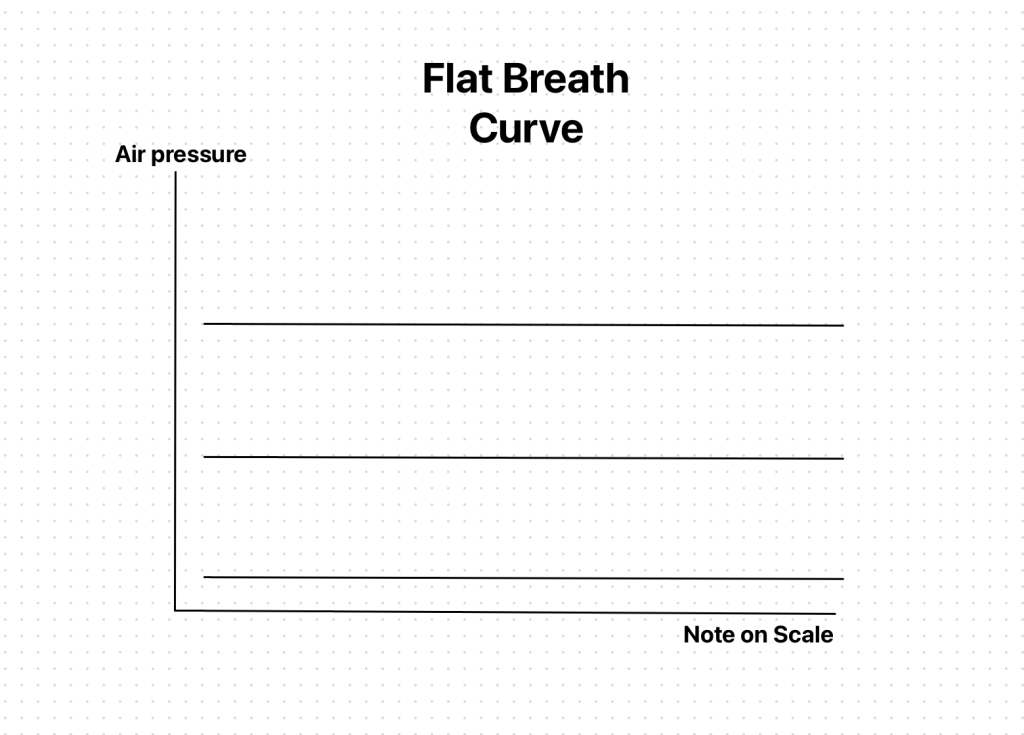
To compare to a linear breath curve, each note above the lowest is tuned more and more slightly sharp so that, for example, a if blowing a high C on a linear curved ocarina, that same air pressure would be incredibly sharp on a flat curved ocarina.
📐 Concave Breath Curves
A concave breath curve requires more air as you ascend to a point and may flatten or actually have a drop in air pressure at the highest notes, like the Night by Noble, where the high F may require less air than the high E.
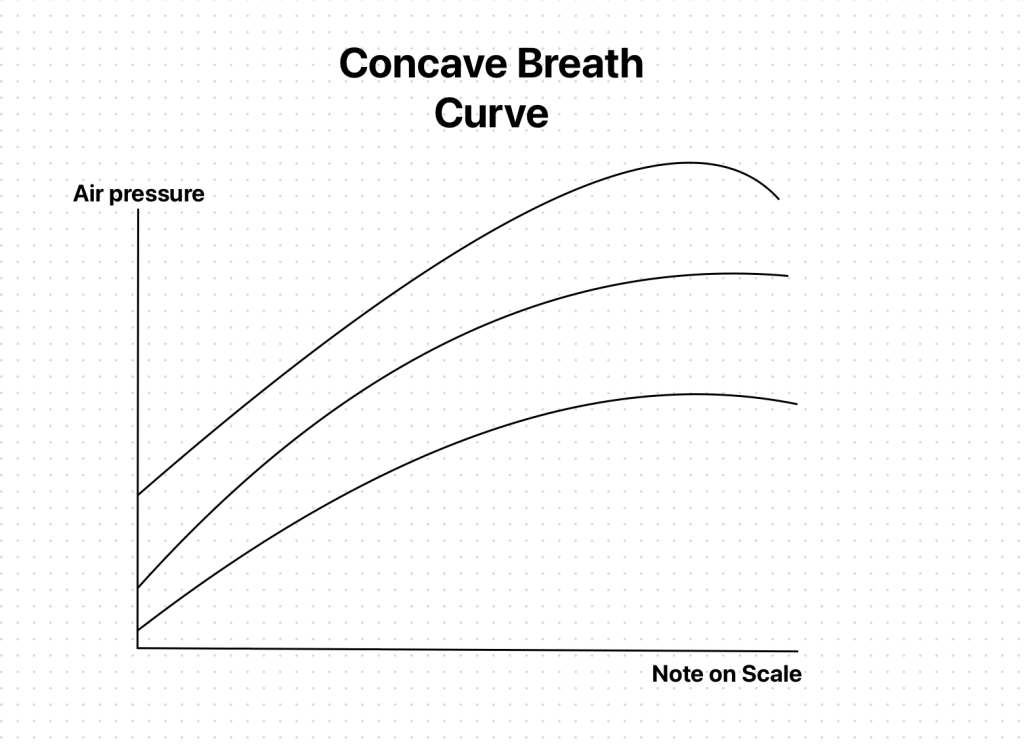
Concave is less intuitive than a linear curve, but it’s not too hard to adapt to. Many Alto C ocarinas have somewhat concave curves, as they either require that you use the acute bend or blow less air to get a clear high F.
An ocarina with a concave breath curve does not mean the ocarina is bad or poorly tuned; it just means it may be less beginner friendly.
💨 How Does Overall Breath Pressure Connect?
A high-breath pressure ocarina with a linear breath curve would have a higher “slope” (how much more air needed per note) a higher “Y-intercept” (the amount of air needed to play the lowest note in tune), or both
Conversely, let’s use a low-breath pressure ocarina with a concave breath curve, the Night by Noble. I am not good enough at math to make an equation, but you can refer to the previous graphs.
The Night by Noble starts out at a low Y-intercept with a relatively linear slope. Then, it flattens around the high E and dips a tiny bit down for the high F; it concaves downward while also having low breath pressure requirements to begin with
⚠️ How a Breath Curve Can Make an Ocarina Out of Tune
When we describe an ocarina as out of tune given these 3 categories, outside of when notes are so far out of tune that they’re beyond saving, it usually means the ocarina doesn’t fit one of these curve models.
For example, if an ocarina feels linear in its breath on C through G but then requires less air on the A, then more air on the B, that’s poorly tuned! There’s no intuitive shape to the breath curve.
If an ocarina follows one of the expected breath curve models, you know what to expect to do with your airflow as you ascend a scale or play wide intervals. An ocarina with an unintuitive or unpredictable breath curve would be out of tune for most players and require a lot of unnecessary extra practice to master.
⭐ Which Curve is Your Favorite?
Let me know in the comments! I assume most of you will prefer linear. If anyone has a flat-curve ocarina, also let me know where I can get it for a showcase. Also, let me know if there are other clear categories of breath curves you’ve encountered, with an example ocarina, so that I can amend this post in the future—please do so via comments on the YouTube video!
 Andy Cormier